Check Valve Installation: Flow Direction, Orientation and Access
Engineering resources
Check Valve Installation: Flow Direction, Orientation and Access
A check valve allows forward flow and closes when the flow conditions would otherwise permit reverse flow.
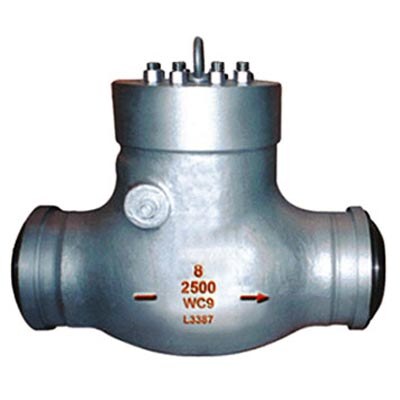
A check valve allows forward flow and closes when the flow conditions would otherwise permit reverse flow. It operates through the interaction of the moving element, fluid forces and, in some designs, a spring or gravity. Installation therefore affects more than whether the flange holes line up: it can affect how the valve opens and closes.
Begin with the exact valve model and its installation, operation and maintenance manual. Val-Matic publishes separate manuals for swing, silent, dual-disc and other check valves, rather than one universal installation procedure. Manufacturer manual library.
Follow the flow arrow
Identify the intended normal flow direction on the piping drawing and compare it with the arrow or other direction marking on the valve. The location of a pump does not substitute for this check; bypasses and parallel branches can make a layout less obvious than it first appears.
A check valve should not be assumed to provide a lockable maintenance isolation. Before installation or service, the system must be isolated, depressurised, drained and made safe under the site’s procedures. Stored pressure may remain on either side of a closed valve.
Orientation depends on the mechanism
A swing valve has a hinged disc; gravity and hinge position influence its movement. A spring-assisted axial valve uses a different closing mechanism. A dual-plate valve adds its own hinge and spring arrangement. Consequently, permission to install one design in a vertical line does not establish permission for another.
Ask whether the model is approved for horizontal flow, vertical upward flow or vertical downward flow. Also ask whether the manufacturer specifies hinge-pin or shaft orientation. A catalogue picture showing the valve upright is not an installation approval.
| Installation question | Document or observation needed |
|---|---|
| Which way does fluid normally travel? | Piping flow direction and body arrow |
| Is this pipe orientation permitted? | Model-specific IOM |
| Is the closing element free to move? | Required clearances and approved inspection procedure |
| Are adjoining components compatible? | Pipe bore, flange and gasket details |
| Can the valve be maintained? | Cover-removal and lifting envelope |
Allow for flow conditions and adjoining equipment
Elbows, reducers and pump discharge conditions can produce uneven or disturbed flow. Follow the manufacturer’s required positioning and straight-run guidance where specified. There is no single straight-pipe distance that can responsibly be assigned to every check-valve design and system.
Selection also needs the operating flow range. A valve that is mechanically compatible with the pipe may not operate stably at the minimum flow. Ask for the information used to establish opening behaviour and pressure loss across the intended operating range, not just at the maximum flow.
Prepare the joint and access space
Protect the sealing surfaces and remove transport protection as directed by the IOM. Pipework should be supported and aligned without using the valve to pull misaligned flanges together. Debris left in the line can obstruct a seat or moving element. Flushing and commissioning methods must be compatible with the installed equipment.
Leave space to reach fasteners and remove the components identified in the maintenance manual. The footprint of the installed valve is smaller than the space needed to lift out a cover or disc assembly. Record this access requirement before surrounding equipment or insulation is installed.
Commission with observations, not assumptions
Use the approved commissioning procedure to introduce flow and observe operation. Unexpected vibration, repeated opening and closing, or a sharp closing event warrants investigation. Do not assume that fitting a spring-assisted valve alone resolves a system transient problem; pump stopping behaviour and the pipeline response may need engineering analysis.
Can a check valve be installed vertically? Some can, within model-specific restrictions. State the direction of vertical flow when requesting confirmation.
Does a larger valve always reduce problems? No. The operating flow and opening behaviour matter as well as pressure loss and pipe size.
Use the check valve family to identify candidate designs, then request the drawing and IOM for the exact selection.
Let’s specify the right valve.
Send your valve list, operating conditions or project datasheet.
Need a valve for your application?
Send your valve type, operating conditions and quantity. Our team can help review the options for your inquiry.
Request a Quote →